
MY ART
Szymon Ćwikliński
“To rediscover, to recreate.”
Artist Statement
In my art, my visions of the afterlife and fantastical realms take form. I am primarily interested in the art of drawing when designing paintings and sculptures. In 2005, my visions intensified, and that period marked the creation of the first sketches of my worlds. My journeys are expeditions into my own inner self, hidden in intimate dreams and visions. Traveling through the world of imagination stems from my belief in the spiritual mission I am meant to fulfill as an artist.
I devote great care to shaping form, so that I can “sculpt” my figures. I strive for perfection in chiaroscuro and harmony of color. I am torn by contradictions, shifting from depictions of women and nature to the darkest of imagery. A pure and serene atmosphere clearly contrasts in my art with the otherworldly scenes, which seem to be made of dark matter suspended in the air. This is the expression of my spiritual life.
In the somber atmosphere that reigns in my paintings, the figures alternately assume the posture of the damned or the redeemed. These two worlds form, to quote William Blake, “The Marriage of Heaven and Hell.” My journeys to the borders of my own spirit result in works filled with unease and metaphysics.
I maintain that what is called the body is a fragment of the soul perceived by the senses. I am fascinated by the figure of the woman. A woman emanates gentleness and beauty, for the body is a manifestation of spiritual energy, and the material world is a reflection of the world of the spirit. Women and demons exist in my work to awaken feeling, to provoke emotion. I place great emphasis on the necessity of using clear, precise line. For me, the perception of infinity is distinctly defined, for infinity is within the human being; it takes human form, and the mission of the artist is to reveal it before them.
Beyond Us
Curatorial text
Who are we beyond? Beyond the patterns and expectations that define us, beyond our physicality, whose limitations are so difficult to escape, beyond life and beyond death, toward which we constantly move? Who can we become, and what worlds might reveal themselves to us when we step onto the path of what lies beyond us? Perhaps it is precisely then that we become part of something greater and begin to fulfill our destiny. These questions—likely forever deprived of the precise answers human minds desire—are what Szymon Ćwikliński explores in his work.
The artist employs both magical and realist forms of representation, expanding through imagination the world we all know so well. In his works lives the spirit of surrealism and dreams; the echo of Lem’s literary universes can be heard, as well as the sensory visual power of his two masters—Beksiński and Siudmak. Ćwikliński does not confine himself to a single medium. In his practice, media transform one into another: drawing inspires painting, and from painting crystallizes sculpture. What unites all of his works is exceptional precision and the powerful energy of both the subjects and the movements of the artist’s hand. Ćwikliński blurs the boundaries between reality and fantasy, drawing inspiration from personal experiences on the threshold of worlds, from states beyond the body and from visions in dreams. As he himself says, he is convinced of the spiritual mission he is meant to fulfill as an artist, and through creation he steps beyond—and fulfills his destiny.
So if we decide to go beyond, what might await us there? Ćwikliński’s works suggest a parallel world, no less real than the one we know. In his paintings, vivid color is essential; in his drawings, the line is subtle yet incredibly clear, saturated with the mystical unease of dreamlike scenes rendered with impressive detail. His central inspiration is the human being in relation to nature and culture, to which humanity is inseparably tied. We see a woman with a captivating gaze whose hair turns into peacock feathers; a man whose skull subtly merges into a Roman amphitheater; the artist’s own face enclosed in the body of a creature resembling a sphinx or a predatory lion. Seemingly unreal and fantastical, in practice Ćwikliński’s works reveal what our daily vision cannot perceive—the world freed from physical boundaries, operating according to the logic of imagination, an expanded reality more subtle than what language can contain. Yet beneath this “magical” layer something startlingly familiar always remains—ourselves.
Crossing beyond is a process, and transitional states have not escaped Ćwikliński’s artistic gaze. In his sculptures—most often created in brass and bronze—the artist plays not only with form, but with reality itself, bending it according to his imagination. At the center of his sculptural work remains the human figure, entangled, more or less consciously, in its environment. These are not full or literal figures, but rather symbols; their bodies bend, lengthen, disappear. The sculpture “Soul” is at once a figure in motion and pure energy, balancing at the threshold of two worlds whose gates are again guarded by “Thanatos.” “Human in the Center” and “Allegory of Gambling,” on the other hand, refer to the context of our surroundings, their influence on our lives, and the courage we must develop to break free from mechanisms that halt our growth.
Szymon Ćwikliński is a bold and perceptive creator, unafraid to search for answers to life’s great dilemmas in parallel worlds, which he translates into his works. Through his art, which probes the meaning of human existence, the artist leads us beyond—onto the path of destiny, which echoes something greater, calling to be discovered.
Kamila Mistarz
Parallel Worlds
Curatorial text
Having observed the work of Szymon Ćwikliński over several years, I have come to the conclusion that it should not be perceived in any way other than through the prism of the artist’s personality. This is the only way to approach this art—at times demanding—without losing its context, without stripping it of subtlety and inner life. There is something in these works that holds our attention longer. We find here references to the artist’s personal experiences, solitary moments, fleeting sensations, and at times observations transformed into universal symbols of a world “distant,” because it is his inner world.
First came drawing, treated autonomously, through which the artist describes the world by shaping the object with line. These are not sketches (even though they now serve as sculpture designs), but finished works, whose forms are wrapped in a lively, at times nearly graphic line. At this stage of the artist’s work, we discern two different worlds, expressed in contrasting forms of representation. Using line as his artistic means, the artist shows the “rational world,” but also the irrational world, unable to free himself from depicting life, and the burdensome transience fulfilled in pain and death. The line is highly varied, subject to deformation to emphasize dynamism, which results in the disappearance of individualizing detail. Szymon does not delve into the mysteries of reality, nor attempt to explain them. It is his own world, materializing in drawing and painting. He accumulates energy, creating living, restless forms full of inner vibration by altering the intensity of density. Human figures, drawn and painted somewhat lyrically, expressively, contrast with the rational world in which they do not fit, and yet they complete it. This is the kind of art I encountered when Szymon first appeared at the Museum.
Thanatos—something that emerged and… These are reflections on mythological and existential motifs. It is a “conversation” about the meaning of life, the passing of time, the beauty of nature, where color—and only color—is the medium of narrating the world. These are organic compositions, shaped into allusive forms of meaning.
Creating art is not easy. Yet I believe that through his sculptures (based on drawings from several years ago), Szymon brilliantly reveals a new world of space, an approach to subject matter unrestrained by limitation. When viewing these works I have the impression that the piece “made itself,” so much delicacy and finesse resides in it. The tension that naturally arises between material and artistic imagination seems, in this case, absent. Szymon’s art is a field of exploration that spans painting, drawing, conceptual investigation, sculpture, graphic art, and what still lies ahead of him.
The strong emotional imprint of his work, the need for mental contact with the viewer, and the desire to focus their attention on the semantics of the piece do not signify a neglect of formal or technical concerns. For me, Szymon remains an open page.
Małgorzata Rynarzewska

LUNA 2

LUNA 3
LUNA

WYTCHNIENIE
The Afterworlds
Curatorial text
The series *Parallel Worlds* by Szymon Ćwikliński presents works belonging to various stages of his artistic practice and to different areas of the visual arts. The largest group consists of drawings executed in pencil or ink, as well as graphic works and poster designs. Less numerous, but strikingly present, are the sculptures.
The artist has long been interested in drawing and continues to perfect this discipline, which is also indispensable in designing his paintings and sculptures. He places strong emphasis on the necessity of using a clear and precise line, following the example of his masters—Beksiński and Siudmak.
The drawings, graphic works, paintings, and sculptures gathered in the exhibition depict diverse motifs. They bring to life unreal beings and imaginary worlds. Often, they materialize serene visions of fantastical realms, but also dark afterworlds, inspired by threshold states of consciousness, existential experiences, and dreams. According to the artist, the mission of the creator is precisely to reveal infinity which, in his view, resides in the human being and takes human form. It exists, among other places, in the imagination.
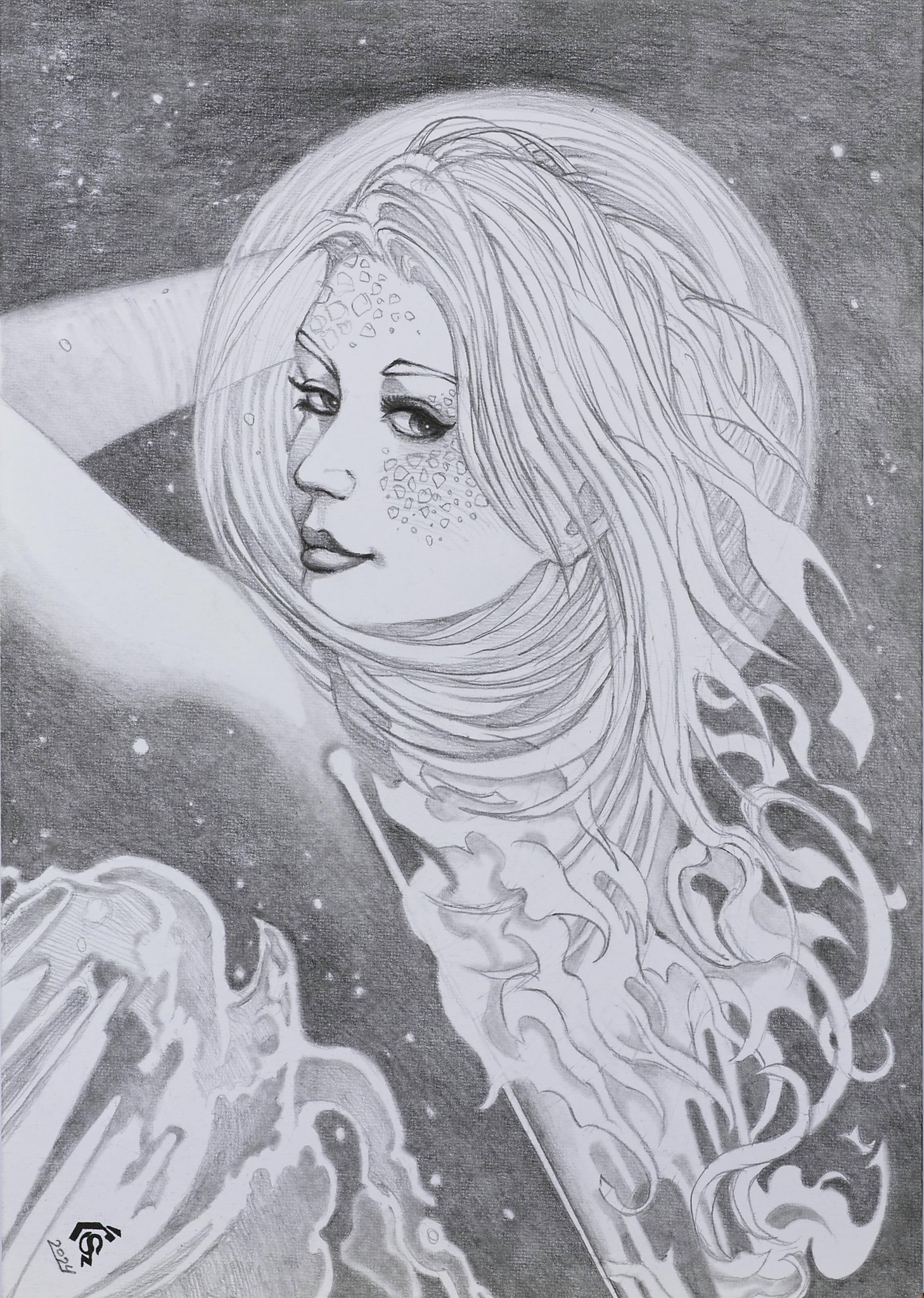
A dominant motif in many works is the female face, whose details—and especially the hair—become a source of artistic play. Long, lush hair becomes the crown of a tree in one work, in another cascading waterfalls, and in yet another bird feathers or a vision of a windy force of nature. These compositions strongly emphasize the connection, even the “intertwining,” of two elements—woman and nature. The artist merges them, recognizing their similarity both in symbolic and visual terms. By doing so, he creates a kind of boundless universe.
The usually serene atmosphere of these drawings clearly contrasts with the depictions of afterworlds shown in several other works, which seem to be made of some dark matter suspended in the air. In one of them we see an intriguing figure in a red robe, whose face is replaced by an element reminiscent of a visor. Its skeletal, death-like hand reaches for—or releases—an element that evokes numerous associations: with a star, with a cross, with light. The red garment also carries complex connotations. It is, after all, a color symbolizing majesty and life, but also suffering, fear, and death. A motif evoking Thanatos can also be found among the sculptures.
In another work, the artist depicted a crowd moving through a surreal, unsettling space that dominates the figures and recalls, among other references, Magdalena Abakanowicz’s *Hand-like Trees*. The composition strongly emphasizes the vertical order, yet numerous diagonals introduce unease, intensified by a figure resembling a visitor from another planet.
Also noteworthy are the drawings presenting the human being within a cultural context, especially the one depicting in profile the head of an older man. The tissues covering his skull blend with architectural elements reminiscent of a Roman amphitheater, inviting various interpretations.
Katarzyna Skarbek-Piętak

TANATOS

ALEGORIA HAZARDU

TANATOS

ALEGORIA HAZARDU
Confessions of the Wind…
Curatorial text
The work of the artist Szymon Ćwikliński is an image, a description, a manifestation of personality—an expression of personal independence, of artistic freedom, of the freedom of one’s own art, even a justification of existence. This art demands to be seen, experienced, touched by sight. To describe it in words misses the point. In all of Ćwikliński’s paintings, the world—like a living being—turns toward us, speaks to us, entrusts us with its songs and colors, and fills us with tremendous joy, lifting us out of solitude. From these encounters remains the memory of the strange enchantment of Ćwikliński’s art, its intimacy, richness, and wisdom, and remains the friendship and love for those true worlds that have expanded the boundaries of our experience. Before these works we stand astonished and captivated. Astonished by beauty in its many faces, and captivated by the wealth of forms, shapes, palettes, the crystallized moment, and the captured happiness found in the tears of “flowers and wet clouds” (where the flower is the human and the artistic event, and the cloud, for example, is the wind in the hair). We experience a kind of joy in befriending these works.
Vantongerloo emphasized that the value of a work depends on the positions that people and things assume in relation to one another. In a painting, the most important aspect is the mutual relationship of elements. In discussing the works of Szymon, we can distinguish different semiological sensibilities. Yet in the foreground, as Roland Barthes calls it, always emerges “the memory of elements.” Memory reveals connections between language and sign like the arc of a rainbow linking two different realms. The first realm is documentary, concrete, tangible reality; the second is poetics, visual art, metaphysics, and “the song of expression.” Art, as Gass observed, is not transparent. The artwork creates a vision beyond itself and through itself. Reaching into what is enchanted in nature and in the world—the sources of mystery and knowledge—becomes a conscious desire of the artist, despite the awareness of its futility. With his works, Ćwikliński breaks beyond temporality, toward another dimension. His works become, in essence, only—or entirely—a poetic transfiguration of facts freshly seen with his own eyes (or in dreams), deeply imprinted in memory. In selected paintings we will not find paroxysms or internal fires, but rather an alert and tender seeing, arising from solitary contemplation. One senses the music of forms and colors, relatively pure and resonant. There is a feeling of surprise, of play, of fantastically layered cultural eclecticism; a wealth of sources and reminiscences opens before us. Ćwikliński knows how to bind the deepest meanings with the highest artistic form. His works burn, as do those of Soutine, Beksiński, and Siudmak. The artist gives direct expression to feeling, capturing the nearly ungraspable vibrations of emotion, and preserving their force, freshness, and charm.
The artist discovers in the world what he already carries within him; yet all discovery requires action. Through action he presents (and describes) himself and the world. His fusion of imagination with reality, of ecstasy with anxious reflection, of intensity with calm, soothes the pain of a certain impossibility (even when it seems otherwise).
He constantly seeks radiance for himself and for others, in faces that seem sculpted, carved in hard matter, in stony, rising landscapes, in the metallic timbre of colors, in the nervous entanglement of lines. He constructs his visual statements freely, almost lightheartedly, and willingly reaches for the language of symbols. The distribution of light and shadow, derived from a rigorous constructive postulate of reduction and opposition, may appear incidental, yet the characters remain situated within their patterns.
He possesses the gift of materializing his imagination. He is able to draw us into his fantastical journey toward the invisible, into the abyss of the creator’s mystery.
He reveals a certain extraordinary artistic madness—one over which he calmly maintains control.
With boundless fantasy he enters the realm of dreams, to wondrously fulfill the long-awaited breath of an unsettled heart.
The art of Szymon Ćwikliński unveils his visions in all their depth. In doing so, it expands a rich palette of colors, signs, lines, symbols, and matter.
In the artist’s work, we see (at times strongly accentuated) an interest in science, particularly psychology and philosophy. Notable too are references to great masters of painting—Velázquez, Ingres, Dalí, but above all Siudmak and Beksiński.
Ćwikliński’s paintings often feature strong chiaroscuro modeling, an intimate yet expressive mood, and at times a noticeable economy of means, with a sunlit and saturated color tone. One is also struck by the subtle color palette set against expansive compositions.
Although Szymon Ćwikliński is a relatively young artist, and borrows certain painterly techniques from many great masters of the brush, he has already developed his own style. His works vary: some possess greater, others lesser pulling force.
Thus despite the rich diversity of subject matter, the traits of his style emerge clearly and align with the techniques he chooses and the themes that in a given moment move him, captivate him, and uplift him.
Happiness, in his case, is not a hazy dream. The artist radiates what fills his heart and mind. We see that Szymon’s life is the transformation of himself into a work of art.
The entire essence of art lies in being oneself—while being exceptional. This is what Szymon Ćwikliński succeeds in achieving.
Leszek Lesiczka

Sculptural Tales
Curatorial text
Reviewing the artistic achievements of Szymon Ćwikliński, who works with drawing, sculpture, and painting, has been a surprising adventure for me. I set up a small game, trying to uncover the sources of inspiration—or simply my own associations. What’s more, I resigned from looking at the titles. The result surprised even me. I encountered elements referencing great masters, ancient mythology, and futuristic visions. There were Cubist, Surrealist, and Expressionist accents—particularly in sculpture—and echoes of Japanese woodcuts. Mixing traditions and different realities, combining cultural references and transforming them yields extraordinary results. In all, there are many ideas, searches, inspirations, and references to different sources—a very interesting artistic path recognized with numerous awards and distinctions.
What does Szymon Ćwikliński tell us through his drawings? What stories, what messages can we decipher? As viewers we are unrestricted—only our sensitivity, experience, and knowledge shape the dialogue we enter with the artist’s works. My perception finds here countless themes and associations. In the self-portraits I detect the echo of Piero della Francesca’s diptych depicting Federico da Montefeltro and Battista Sforza, transformed, in a way reminiscent of Beksiński, into eroded stone, through which the artist assigns new meaning and speaks of solitude in togetherness and the impossibility of change. Yet moments later, in another work, there appears a passionate kiss inspired by the style of Japanese woodcut, offering hope for the victory of emotion. Or perhaps the order should be reversed?
A second theme emerges: the human being as a victim of the changes they themselves imposed on the world. In particular, environmental destruction, where dominant, threatening plumes of smoke rising from chimneys slowly rob life of joy and force us to seek refuge from the world we ourselves created. In a subsequent sequence we see smog-filled cities, a couple unable to function without protection, and, at the culmination, a small figure piercing through the choking mass of smoke and flame—for nothing else remains. Is this a warning?
The depictions of young women are especially intriguing. Beautiful, youthful faces are accompanied by floral, avian, or cosmic attributes. These may be interpreted as hidden traits, passions, or desires. Two works especially drew my attention. The first shows a delicate face contrasted with hair forming three ominous birds—either as guardians or, conversely, symbols of the predatory instinct of this seemingly innocent figure. The second depicts a character with three female heads. Perhaps connecting it to the Three Graces is too far-fetched, let alone to a three-headed dragon, yet the floral bouquet in the hair, enriched with living forms, evokes Dutch still lifes reflecting on transience. Was this the artist’s intention? Or perhaps it simply alludes to the multiplicity of human character? I was also intrigued by the formal reference to Alphonse Mucha—his flowing, Art Nouveau contour lines and lyrical poetics.
It is fascinating to discover in Ćwikliński’s work elements known from masterpieces or mythic narratives. We find mythical references: the silhouette of a swan behind a pair of lovers, recalling the story of Leda; a serpent emerging from a woman’s hair, evocative of Medusa; and a figure combining three narratives—Mercury, an angelic being, and the flaming presence of the Holy Spirit—or, with unrestrained imagination, a fourth, Samson, about to perish beneath the ruins of the temple he destroys. A nude woman against a fiery background can be linked to *Venus Pudica*, so frequently invoked by great painters. This energy-laden background combined with the female figure also evokes the well-known song by Dżem. We also see the victorious gesture of St. Michael the Archangel, guiding us toward Leonardo’s masterpieces, and an unusual depiction of Michelangelo’s David as a mirrored image with an added wing. What a field for personal interpretation.
Ćwikliński also expresses himself in sculpture. His works are extraordinarily dynamic and lead my thoughts to worlds created by fantasy authors. If this is a vision of humanity’s future, we might ask: what went wrong? Alongside fiery, partly humanoid figures appear animals depicted with remarkable expression. One sculpture that caught my attention shows a figure perhaps symbolizing a human, holding a die behind the back. There is a tension pushing forward, toward the future, yet simultaneously restrained by fate symbolized by the cube. Of course, fate is understood differently by each of us, but one could read this as a superposition of our actions and intentions with events beyond our control. This is precisely how life progresses. I was particularly struck by a work showing a human figure trapped with a boulder in a cog mechanism, reminiscent of the myth of Sisyphus. Looking at it, I feel that—according to the laws of physics—it will soon begin to roll down the slope, and subconsciously I am puzzled that it does not. But what will happen to the figure? In my imagination, it is crushed by the boulder. Perhaps that is why, through the artist’s will, it remains suspended in its position, radiating extraordinary potential energy.
These are only a few of my associations—impulses leading to the creation of our own narratives while encountering the art of Szymon Ćwikliński. Here we find the human being entangled in life, torn by passions, good and evil, past and future, struggling with fate, as well as reflections on various aspects of the world around us. I warmly encourage you to devote time and attention to his works. Dialogue with art is always an extraordinary adventure.
Jan T. Kozłowski